
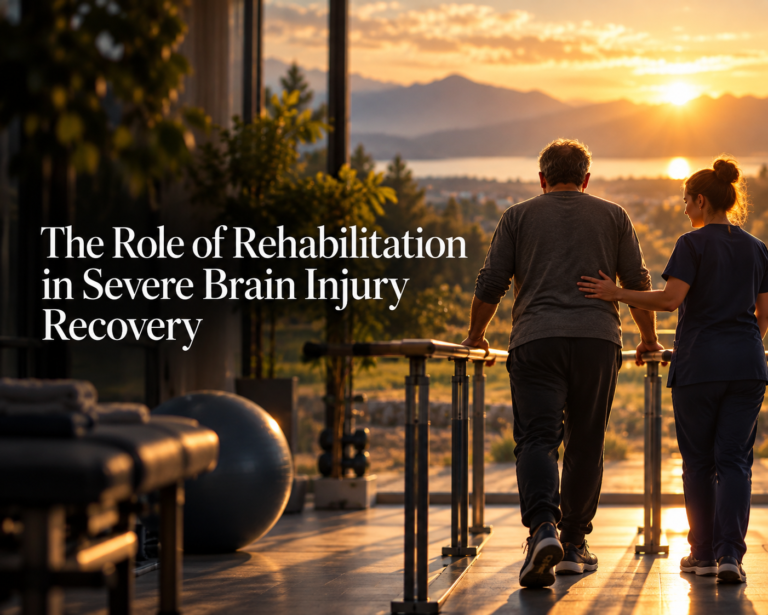
There is a point after a major injury when surviving is no longer the only goal. The next question becomes much more personal: how do you live again? Brain injury rehabilitation begins inside that question. It can mean learning how to sit safely, form a word, hold a spoon, take a step, or complete a task that once happened without thought. For James Heather, recovery after his catastrophic fall in Paris was not built around one dramatic breakthrough. It was shaped by repeated attempts, frustrating days, small improvements, and the slow return of everyday independence.
His experience shows why rehabilitation cannot be reduced to exercises on a schedule. It reaches into almost every part of a person’s life.
The Work Starts After the Emergency Is Over
When James fell eighteen feet onto a marble floor in a Paris hotel, the first priority was simply keeping him alive. He suffered severe head trauma, underwent emergency surgery to relieve pressure on his brain, and spent weeks in a coma.
Those early days were about survival.
Later came a very different kind of challenge.
When consciousness returned, James still had to deal with the consequences of the injury. His mind could understand far more than his body could express. His speech was severely affected. Movement was difficult. Eating required assistance. His right side had been badly damaged. Even the simple ability to tell someone what he wanted could become exhausting.
This is where brain injury rehabilitation becomes deeply personal.
The goal is no longer simply to stabilize a patient. It is to help a person reconnect with ordinary life, one ability at a time.
James’s story makes that distinction impossible to miss. The man recovering in a hospital bed was the same man who had once flown commercial aircraft, travelled widely, entertained friends, and relied on confidence and quick humour in almost every social situation.
The distance between those two versions of daily life was enormous.
Also read : Why Stories of Survival Continue to Inspire Readers
When the Simplest Actions Become Serious Goals
The word “rehabilitation” can sound formal and medical. The reality can be surprisingly ordinary.
For James, recovery included tasks such as eating, speaking, standing, walking, coordinating his hands, and eventually looking after himself more independently.
Before his injury, he did not have to think about most of those actions. Afterwards, many of them required deliberate effort.
That change is one of the hardest things to understand from outside a recovery room.
Imagine having to concentrate on movements you have performed thousands of times, imagine knowing exactly what you want to say but being unable to make your mouth produce words clearly enough for someone else to understand.
Imagine needing help with food when you once managed complex aircraft systems for a living.
The task itself may look small. The effort behind it is not.
That is why progress after a serious brain injury has to be measured differently.
Physical Recovery Begins With What the Body Can Do Today
One of the clearest parts of James’s recovery involved rebuilding physical ability.
Extended periods in bed had weakened his muscles. His balance and coordination had changed. His right side remained far more affected than his left.
Even his feet and ankles needed attention after weeks of inactivity.
At one point, his father, Rod, was advised to buy him trainers to help support his feet and ankles in a more natural position. James’s response was wonderfully familiar: he disliked them because they were not fashionable enough.
It is a small moment, but an important one.
The injury had changed almost everything, yet James was still James.
His preferences had survived, his personality had survived.
His ability to complain about bad shoes had certainly survived.
Rod also began working through simple physiotherapy routines with him during visits. The exercises gave father and son something practical to focus on while James slowly rebuilt strength.
Progress Did Not Always Look Dramatic
Physical improvement rarely arrived as a cinematic moment.
It appeared in repetition.
Move the leg again.
Try to stand.
Shift the weight.
Find the balance.
Take another step.
James also spent time in hydrotherapy, where the water gave him a temporary feeling of freedom from some of the limitations he experienced on land. His left arm moved more easily than his severely affected right side, yet even those sessions could bring uncomfortable reminders of how much control he had lost.
This is one reason traumatic brain injury recovery stories matter. They show that progress can be both encouraging and humiliating within the same hour.
Recovery rarely asks a person to feel only one thing at a time.
Also read : Life After Traumatic Brain Injury
Getting a Voice Back Can Mean Getting Part of Yourself Back
James had always been a talker.
He told stories, he joked, he charmed people. He relied on timing, expression, and quick responses.
Then speech became one of the hardest things he had to rebuild.
While the tracheostomy tube remained in place, speaking was impossible. Once it was removed, producing understandable words still demanded enormous effort.
One of his first attempts at saying hello barely sounded like the voice he remembered.
People outside his immediate family often struggled to understand him. Medical staff sometimes needed several attempts before they could work out what he was trying to say.
That kind of difficulty reaches far beyond pronunciation.
Communication affects independence.
It affects relationships, it affects confidence.
It affects how easily someone can ask for help, make a joke, explain discomfort, disagree, flirt, tell a story, or simply join a conversation.
For that reason, brain injury speech therapy recovery is not only about producing clearer sounds. In James’s experience, communication was closely tied to getting back a part of the identity he had always expressed through words.
The manuscript describes the frustration vividly: his thoughts were present, yet his ability to communicate them had fallen far behind.
Communication Can Be Exhausting Even When the Mind Is Working
One of the more difficult parts of James’s early recovery was the gap between thinking and speaking.
He could understand much more than he could communicate.
That meant people could easily underestimate what was happening inside him.
Early communication sometimes depended on blinking for yes or no, recognizing objects, following commands, and later using gestures or miming when words failed.
From the outside, those exchanges might appear basic.
From James’s perspective, they represented access to the world.
Being able to communicate “yes,” “no,” or “water” meant that he was no longer entirely trapped inside silence.
That matters enormously in TBI recovery, because progress is not always obvious to someone watching from the doorway.
Sometimes the breakthrough is simply being understood.
Eating Can Become Part of Relearning Independence
Food is another example of how recovery can transform an ordinary part of the day.
When James came off intravenous feeding, he could initially eat only very soft foods. He particularly liked raspberry Petit Suisse and chocolate, and his mother searched local shops to keep him supplied.
But enjoying food and eating independently were two different things.
At first, James did not have enough hand and mouth coordination to feed himself. Someone else had to use the spoon.
That experience strips independence down to its most basic level.
Eating is usually private, automatic, and personal. Suddenly needing someone else to control the spoon can make a person sharply aware of what has changed.
Yet this is precisely why these tasks matter during brain injury rehabilitation.
The aim is not merely to complete an exercise successfully. It is to restore enough control for the person to participate in their own daily life again.
A spoon can become part of that process.
So can a toothbrush.
A shirt button.
A cup.
A staircase.
A journey outside.
Independence is rebuilt through ordinary objects.
Rehabilitation Also Happens Inside the Person
Physical recovery is visible. Emotional adjustment is harder to see.
James had gone from independence, flying, social confidence, and constant movement to hospital routines and dependence on other people.
That creates a different kind of work.
A person has to deal with frustration when the body refuses to cooperate.
They may feel embarrassed when someone cannot understand them, they may resent needing help.
They may become impatient with slow progress, they may compare every new attempt with how easily they could do the same thing before.
That emotional tension appears throughout Above Us Only Sky. James does not move through recovery as an endlessly positive patient. There are difficult moments, awkward moments, humiliating moments, and moments where humor is the only useful response.
That makes the story more believable.
The psychological work of recovery is not about pretending everything is fine. It is about continuing even when it clearly is not.
Also read : Finding Strength During the Hardest Days of Recovery
Family Cannot Do the Recovery for You, but They Can Keep You Going
Sue and Rod Heather played an enormous role in James’s recovery.
First, they stayed beside him through the uncertainty in Paris. Later, they moved into his Fulham flat so they could remain close while he received treatment at Charing Cross Hospital.
They brought food.
They attended visits.
They encouraged exercises.
They helped with communication.
They dealt with practical arrangements.
Most importantly, they continued to treat their son as someone with a future.
That support did not mean doing everything for him forever.
Good support often creates the conditions in which someone can gradually begin doing more for themselves.
The balance matters.
Too little help can leave someone overwhelmed. Too much can unintentionally remove opportunities to practice independence.
In James’s case, brain injury rehabilitation gradually became a shared effort without becoming someone else’s recovery.
His parents could encourage him to move.
They could believe he would walk.
But James still had to take the steps.
Why Small Wins Matter More Than People Realize
People naturally notice the large milestones.
Walking again.
Leaving the hospital.
Travelling alone.
Returning to a hobby.
But those moments are usually built from hundreds of smaller ones.
A useful way to understand long-term recovery is to look at what comes before the milestone:
- Sitting with better balance;
- Transferring more safely;
- Controlling a hand for slightly longer;
- Producing a clearer word;
- Completing part of a personal-care routine;
- Walking a little farther;
- Managing frustration after an unsuccessful attempt.
None of these achievements would have impressed James before his accident.
Afterwards, they became building blocks.
That change in scale is central to recovering from severe brain injury.
A person may still want major goals, but the route toward them often runs through tasks so ordinary that most people never notice themselves doing them.
Recovery Does Not Move in a Straight Line
One of the easiest mistakes to make when talking about recovery is to imagine a staircase.
- Step one.
- Step two.
- Step three.
Better every day.
Real recovery can be much less organized.
A good morning may be followed by an exhausting afternoon. One skill may improve while another remains stubbornly difficult. Confidence may rise after an achievement and fall after an awkward social encounter.
James experienced major progress, but that progress did not remove every limitation.
His right arm continued to cause problems.
Speech remained imperfect.
Group conversations could be difficult.
Some activities required more preparation.
Daily life often moved at a different pace.
This does not cancel the recovery.
It defines its reality.
Progress can exist without perfection.
Also read : What It Really Takes to Start Over After a Brain Injury
The Goal Eventually Changes From Recovery to Living
At the beginning, recovery can dominate everything.
Appointments.
Exercises.
Assessments.
Medical conversations.
Movement.
Speech.
Food.
Sleep.
The injury seems to fill every available part of life.
Eventually, however, something important has to happen.
Life has to become bigger than treatment.
For James, that happened gradually.
He began navigating more of the world independently, he travelled, he rebuilt friendships, he dealt with relationships, he used public transport, he walked dogs, he returned to skiing, he sailed, he went paragliding, he later earned a PADI scuba qualification.
These were not hospital exercises.
They were life.
By 2023 and 2024, diving had become another example of how far the definition of possibility had changed. James initially struggled underwater but improved enough that his instructor needed to make fewer corrections.
The significance is not that he returned to exactly the man he had been.
He did not.
The significance is that recovery eventually gave him enough room to become someone who could still experience challenge, freedom, humor, friendship, and adventure.
Rehabilitation Is About More Than Restoring What Was Lost
That is where brain injury rehabilitation reaches beyond the therapy room. Its deeper purpose is not to manufacture an exact copy of the person who existed before the injury. It is to help someone develop enough ability, confidence, and practical control to participate meaningfully in the life available to them now.
For James Heather, that process took years and never became perfectly finished. Perhaps that is the point. Recovery did not return him to December 2002. It carried him forward.
Frequently Asked Questions
The exact process varies from person to person. In James Heather’s experience, recovery involved communication work, physical exercises, hydrotherapy, eating, rebuilding coordination, learning daily routines, and gradually increasing independence. A person’s own rehabilitation program should be determined by the professionals managing their care
Speech affects far more than conversation. It can influence independence, relationships, social confidence, the ability to express needs, and a person’s sense of identity. James found communication particularly difficult because storytelling and humor had been such important parts of his life before the accident.
James’s memoir describes progress and new achievements continuing long after the first hospital phase. His later experiences included skiing, sailing, improv comedy, travelling, and scuba diving. However, every injury and recovery path is different, so one person’s progress should not be treated as a prediction for another.
Family members can provide practical help, patience, encouragement, transportation, companionship, and support with routines. James’s parents were closely involved throughout his recovery, but the memoir also shows that the injured person still has to do the difficult work of rebuilding skills and confidence personally.
Not necessarily. In Above Us Only Sky, success is not presented as erasing every consequence of the injury. James continues to live with physical and communication challenges. His progress is better understood through adaptation, growing independence, new experiences, and finding meaningful ways to live alongside what changed.